
Ebook Visual Basic for Applications 5 Bible, by Joel Scott
Due to this e-book Visual Basic For Applications 5 Bible, By Joel Scott is offered by on the internet, it will relieve you not to publish it. you can obtain the soft documents of this Visual Basic For Applications 5 Bible, By Joel Scott to conserve in your computer system, gadget, as well as a lot more tools. It depends on your readiness where as well as where you will certainly check out Visual Basic For Applications 5 Bible, By Joel Scott One that you need to consistently keep in mind is that checking out book Visual Basic For Applications 5 Bible, By Joel Scott will endless. You will have eager to review other e-book after completing a book, and it's continuously.
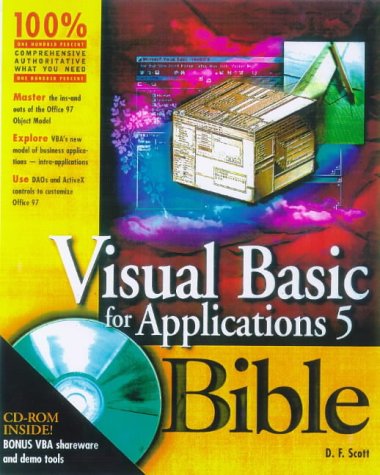
Visual Basic for Applications 5 Bible, by Joel Scott

Ebook Visual Basic for Applications 5 Bible, by Joel Scott
Visual Basic For Applications 5 Bible, By Joel Scott. What are you doing when having extra time? Talking or browsing? Why don't you attempt to check out some publication? Why should be checking out? Reviewing is one of enjoyable and also satisfying activity to do in your extra time. By reading from several sources, you could find new details and also experience. The books Visual Basic For Applications 5 Bible, By Joel Scott to read will be various beginning with scientific e-books to the fiction books. It means that you can check out guides based upon the necessity that you intend to take. Of course, it will be different as well as you could read all book types whenever. As here, we will certainly show you a publication ought to be checked out. This publication Visual Basic For Applications 5 Bible, By Joel Scott is the selection.
As understood, book Visual Basic For Applications 5 Bible, By Joel Scott is well known as the window to open the globe, the life, and new thing. This is exactly what the people currently need a lot. Also there are lots of people that do not like reading; it can be an option as reference. When you really require the methods to create the next motivations, book Visual Basic For Applications 5 Bible, By Joel Scott will actually assist you to the way. Furthermore this Visual Basic For Applications 5 Bible, By Joel Scott, you will certainly have no remorse to obtain it.
To obtain this book Visual Basic For Applications 5 Bible, By Joel Scott, you could not be so baffled. This is on-line book Visual Basic For Applications 5 Bible, By Joel Scott that can be taken its soft documents. It is various with the on-line book Visual Basic For Applications 5 Bible, By Joel Scott where you could get a book and after that the seller will send the printed book for you. This is the location where you can get this Visual Basic For Applications 5 Bible, By Joel Scott by online and after having deal with purchasing, you can download and install Visual Basic For Applications 5 Bible, By Joel Scott by yourself.
So, when you require quick that book Visual Basic For Applications 5 Bible, By Joel Scott, it doesn't have to get ready for some days to obtain the book Visual Basic For Applications 5 Bible, By Joel Scott You could straight obtain the book to save in your device. Also you love reading this Visual Basic For Applications 5 Bible, By Joel Scott anywhere you have time, you could appreciate it to review Visual Basic For Applications 5 Bible, By Joel Scott It is certainly helpful for you which wish to get the much more priceless time for reading. Why do not you spend 5 minutes and invest little money to get the book Visual Basic For Applications 5 Bible, By Joel Scott here? Never allow the extra point goes away from you.
Office 97 users are given VBA (Visual Basic for Applications) as a development platform, and this text offers to show users how to use the feature that's already at their fingertips. It examines the Office 97 object model, without which there wouldn't be a VBA, and presents a model of the business application. The CD-ROM includes all the source code used in the book, along with shareware and demonstration tools.
- Sales Rank: #9555580 in Books
- Brand: Brand: John Wiley Sons Inc (Computers)
- Published on: 1998-04-08
- Original language: English
- Dimensions: 9.28" h x 1.82" w x 7.48" l,
- Binding: Paperback
- 656 pages
- Used Book in Good Condition
Excerpt. � Reprinted by permission. All rights reserved.
Packaging and Distributing VBA Modules
Excerpted from Chapter 8 of
Visual Basic� for Applications 5.0 Bible
by D. F. Scott
Featuring:
Examining the virtues of VBA modules Looking at redistributable code for Office 97 applicationsBefore I begin the journey into the specifics of the Office 97 object libraries, let's take a few pages to ponder the matter of how multiple users will make use of the VBA modules that you write. A complex VBA module that requires more than one Office 97 application to be installed, plus the services of one or more of Microsoft's so-called shared components, plus any number of extra fonts and drop-in controls, tends to be tailored to the system on which it originated. It worked on your system, so because this is for Office 97, shouldn't it work on everyone else's?
The VBA Module As Installable Component
It isn't terribly likely that a major VBA exercise composed on one system can be transplanted to some other system with the expectation that it will work or even perform in the same manner. The Windows setup on most users' systems tends to become personalized over time. Simply because you have some resource available on your system does not mean that all of your users have that same resource, or even have the means to attain that resource. A custom ActiveX control, a specialized font, or the presence of some other application or "in-process server" used by your VBA module requires some way to be transported to your users' systems. (More about the in-process server in the next chapter.)
Part of the problem is that a VBA module is not, at its core, an encapsulated element of executable code like any other program you might try to write. You're not giving away something that shows up in Windows Explorer as an .EXE file with its own icon that a user might double-click to run. Instead, a VBA module is an intrinsic part of a document, some other data product, or the template used withinthe Office 97 application in the production of that product. Your users maynot know they need or have (even after installation) the functionality you're distributing. A VBA module is that much more shy, if you will, than your ordinary redistributable application.
If this were a Visual Basic 5.0 project, you could compile your source code into a standalone .EXE file. This file could contain so-called p-code or "processor code" that consists of the rudimentary symbols needed by a certain dynamic link library, MSVBVM50.DLL, to recognize your instructions and run your application. With version 5.0, it is now also possible for you to build true, standalone executable code for your .EXE file that doesn't require the presence of the VB runtime dynamic link library. But as I've said so many times before, VBA is not Visual Basic . . . per se. The VBA module does not stand alone, in an Explorer window or anywhere else. It is a melded part of one of the data products of an Office 97 application. So in order for you to distribute the functionality of a VBA module, it has to be joined with the container of that data product, even if that container is otherwise quite empty.
Packaging redistributable code for Access
Furthermore, within the package that it must be redistributed with, a VBA module must make certain assumptions about the nature of the data that also constitutes that package. Consider a module or set of modules for Access 97, for instance. A majority of the ideas for a VBA module that you might come up with probably concern actions that related to a particular database or structure of database (atleast, this is true for me). In other words, most of the extended functionality conceived for Access happens to concern specific databases or database schemas. While a Word 97 template aids the user in composing a multitude of documents based on a specific style, most Access 97 users operate a builder (Access' term for the basis of a database) to devise the single database that the business will continually use for its intended purpose. The Access user doesn't borrow a builder to make cookie-cutter copies of multiple databases with the same type because a business doesn't need multiple databases of the same type -- generally just one.
The type of VBA module you would want to redistribute to Access users as an all-purpose device issued for that module's own sake (rather than to aid in the processing of a specific existing database) would be an add-in that works like a wizard or a builder that aids the Access user in developing a new database or maintaining any other existing database that it happens to encounter. An Access 97 add-in is packaged within an .MDA file, which is classified as an Access library database. The difference between this and an ordinary Access database is that the .MDA file is designed to contain routines that are addressable from the other VBA modules belonging to dedicated Access databases. Many different Access databases can utilize the VBA routines and modules packaged within a library database. But a library database, while it is a library, is also still a database -- which means that it has a database schema stored with it, even if it's blank. It isn't a standalone executable file.
If the library database isn't to be designed to address a database with a particular schema (because a business or a group of network users don't generally use more than one database with the same schema), then it probably should be designed to ascertain the schema of whatever database to which it is to be applied. This means that the library database (blank or not) should be designed to be "database- neutral," learning about the characteristics of the active database on which it will operate by means of polling its object properties.
Most helpful customer reviews
0 of 0 people found the following review helpful.
Does a poor job covering basics, but valuable otherwise
By A Customer
I gave the book a lower score than it deserves because it tries to be a "bible" for both begineers and experienced users. The sophisticated stuff is great and worth a read. I suspect this mess is the editor's fault and not the author, since he clearly knows how to write. If you have gotten past the begineers level, try it.
8 of 8 people found the following review helpful.
Waste of time and money
By A Customer
This book is obviously written by someone who can write well and has a master of the language. Trouble is, he seems to make quite an effort to show the reader. Throughout the book, topics that could be explained in a few straightforward paragraphs get mangled in 5 or more paragraphs, sometimes taking pages to explain. Hey, I love to read. But a technical book should get to the point and explain things clearly. The author loves to take the reader down "the side streets" -- offering anecdotal explanations of the "whys." But to me, that just doesn't seem appropriate in the middle of explaining an important topic. At least put the anecdotal stuff in a side bar and label it as such. I needed a book that gave me good solid information on VBA, and trying to get that out of this book takes WAY too long. I am sure there are better books out there for learning VBA. Personally, I learned most of my VBA from the Wrox Access97 VBA book. And I have the O'Reilly VB & VBA In a Nutshell. I reference that book almost daily. I highly recommend both the O'Reilly book and the Wrox book (even though the Wrox book is geared toward Access). Don't believe the "Reader Level: Beginning to Advanced" on the back of Visual Basic for Applications 5 Bible. It's really not either. This book will most likely confuse beginners (see the explanation of the difference between macros and code modules in Ch.1) and frustrate more advanced users of VB/VBA (see the long-winded discussion of VBA and COM in Ch. 9).
0 of 0 people found the following review helpful.
Interesting but Verbose
By johare4
This book provides a lot of digression on topics that might be interesting to a reader. Things like what might motivate Microsoft's decisions, historical figures and occurrences, the philisophical issues behind some software design. Personally I enjoyed these diversions, but they are not germane to learning VBA. From the learning standpoint, the author does not provide an approach that builds up step by step, as texts do. He believes in the immersion approach, dumping the reader in the deep end and providing enough help that you don't drown. However, only gradually do you grasp the situation and begin to piece it together. I'd say that this book will accomplish its purpose and contains a lot of pertenant info, but it does require patience, and a willingness to let the author ramble in the hopes that he is going somewhere.
Visual Basic for Applications 5 Bible, by Joel Scott PDF
Visual Basic for Applications 5 Bible, by Joel Scott EPub
Visual Basic for Applications 5 Bible, by Joel Scott Doc
Visual Basic for Applications 5 Bible, by Joel Scott iBooks
Visual Basic for Applications 5 Bible, by Joel Scott rtf
Visual Basic for Applications 5 Bible, by Joel Scott Mobipocket
Visual Basic for Applications 5 Bible, by Joel Scott Kindle
0 komentar:
Posting Komentar